The impact of aircraft noise depends on the stage of the journey. While planes fly over most parts of Auckland in the space of a week, our immediate neighbours are most impacted by aircraft take-offs and landings, which is when most people notice aircraft noise. Our near neighbours may also experience aircraft noise during ground movements and engine testing.
More than 420 flights land and take off at Auckland Airport every day. As a result, almost all of Auckland experiences some overflight by arriving and/or departing aircraft.
If you are interested in viewing the amount of overflight that happens in Auckland’s skies over a seven day period, you can use our interactive mapping tool.
If you have a concern about a particular flight, click here.
It is during take-off and landing that aircraft noise is most noticeable to most people. Taking off, that is largely due to the engine thrust. Landing, flaps and landing gear generate extra noise.
Click here to see a map of the three areas in Auckland most affected by aircraft noise.
The three areas are known as the High Aircraft Noise Area (HANA), the Moderate Aircraft Noise Area (MANA) and the Aircraft Noise Notification Area (ANNA). Land within the HANA and MANA is subject to special controls, to manage the impacts of aircraft noise.
The three areas and the average noise (in decibels or dB) they experience over a 24-hour period are:
- High Aircraft Noise Area (HANA), 65 dB Ldn
- Moderate Aircraft Noise Area (MANA), 60 dB Ldn
- Aircraft Noise Notification Area (ANNA), 55 dB Ldn
Every year, Auckland Airport prepares maps which show predicted levels of aircraft noise known as noise contours. This year, Auckland Airport has forecast noise contours for the two years to 30 June 2026. Click here to view the most recent map.
Auckland Airport’s immediate neighbours may also experience noise from aircraft movements on the ground, including engine testing. Levels of aircraft noise on the ground are closely monitored to ensure they remain below acceptable levels.
Aircraft noise is measured using a New Zealand standard which has been especially developed for the task, following international best practice.
Noise levels are recorded in decibels (dB) and averaged over a 24-hour period. A 10 dB penalty is added during night time hours (between 10pm and 7am) to account for sleep disturbance. This means one flight between 10pm and 7am is equivalent to 10 flights during the day, for compliance monitoring purposes.
This average day night measurement of noise is called Ldn.
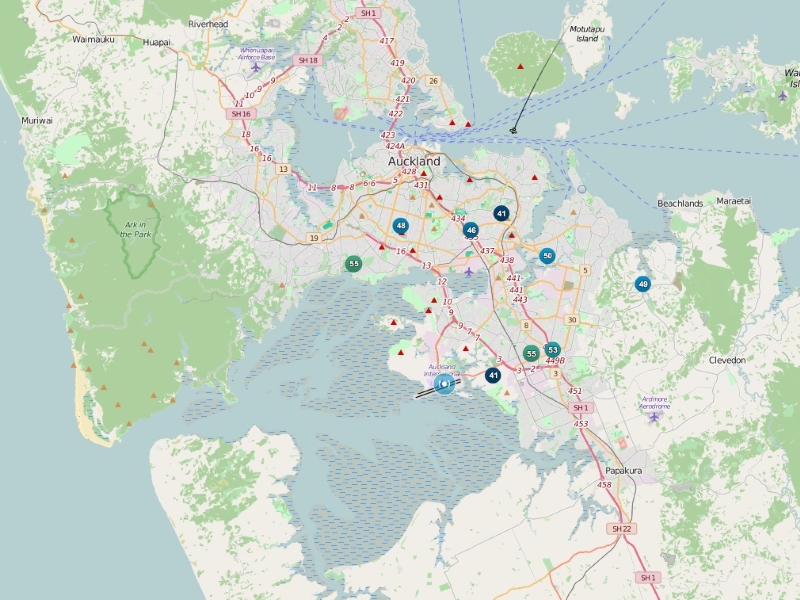
Auckland Airport has three permanent aircraft noise monitors, installed at Prices Road, Puhinui School and the Manukau Velodrome. We also have a number of temporary, portable monitors to monitor noise in the wider Auckland community. View all the locations of our aircraft noise monitors here.
The monitors record aircraft noise and send the information to our aircraft noise and operations monitoring system, where it is matched with any aircraft in the area at the time using flight track data sourced from Airways New Zealand.