SMART Approaches are satellite‑guided flight paths used by some aircraft when arriving at Auckland Airport. They use modern navigation technology to guide aircraft along more precise and predictable arrival routes than traditional approaches.
This technology can allow aircraft to descend more smoothly and continuously during arrival. Where conditions allow, this can reduce the need for changes in engine power or the use of speed brakes, which are factors that influence fuel use, emissions and aircraft noise.
SMART Approaches are part of wider international changes as airspace and air navigation systems are modernised.
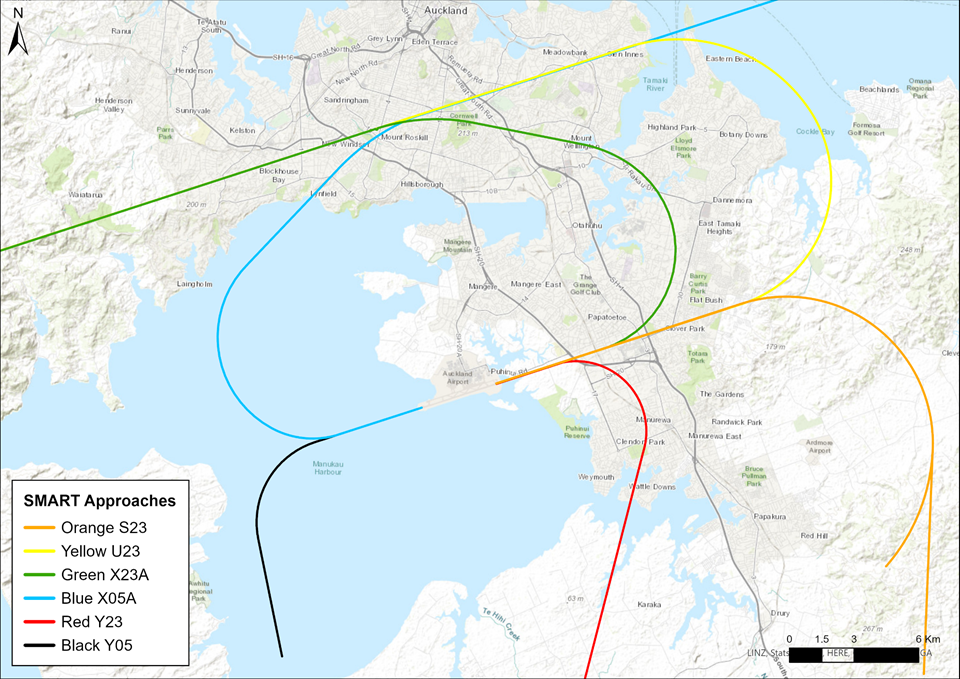
The aviation system continues to evolve to support safe, efficient and reliable aircraft operations. Satellite‑based navigation plays an important role in this by enabling more accurate flight paths and making better use of available airspace.
At Auckland Airport, SMART Approaches are used to manage how aircraft arrive at the airport, alongside other operational procedures and requirements. Their use aligns with the Government’s National Airspace and Air Navigation Plan and international aviation standards.
SMART Approaches have been used at Auckland Airport for more than a decade. From time to time, trials are undertaken to better understand how these approaches are used in practice and how changes to their operation may affect communities.
Trials are used to examine factors such as safety, operational efficiency, fuel use, emissions, and how aircraft movements and noise are experienced on the ground. Importantly, trials are time‑limited and designed to support learning before decisions are made about any longer‑term changes.
Outcomes of the SMART Approach trials here.
We know that aircraft noise affects people differently, and that changes in frequency can be just as important as how loud aircraft are.
SMART Approaches are designed to influence how aircraft are flown, but how noise is experienced on the ground also depends on where flight paths are located. More precise navigation can mean aircraft follow tighter, more consistent corridors, which can affect how often aircraft are heard in some areas.
This distinction - between aircraft noise levels and how overflights are experienced - is a key reason trials and monitoring are undertaken.
The use of SMART Approaches at Auckland Airport is governed through agreed aviation procedures involving Auckland Airport, Airways New Zealand and airlines.
These arrangements include:
- defined conditions around when and how SMART Approaches can be used
- monitoring of flight track and operational data
- review processes to identify and address issues if they arise
Advances in aircraft and engine design mean many aircraft today are quieter and more fuel‑efficient than earlier models. Newer aircraft types generally have smaller noise footprints and continue to improve environmental performance.
At the same time, population growth and increased housing density mean aircraft movements can be more noticeable for some communities. Managing aircraft noise is therefore a shared responsibility across the aviation system, involving airlines, air navigation services, airports and regulators.
SMART Approaches continue to be reviewed as part of Auckland Airport’s broader work on airspace planning and aircraft noise management. This includes learning from trials, monitoring operational data and working with aviation partners as systems evolve.
Community feedback, alongside technical data, plays an important role in informing this work.