
October 2026
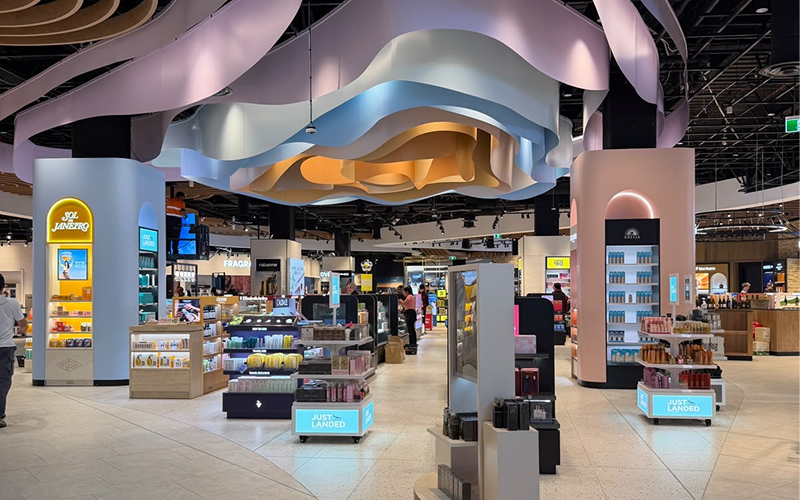
Upgrades to the international terminal's duty-free stores have progressed well this year. With transformed stores reopened in Piers A and B, along with Arrivals, the final stage of works is now underway in the Departures Duty Free store.
Key updates
Stage 3 of the Departures Duty Free store is now complete and open to travellers.
Final Stage 4 works are now underway and are expected to be completed by mid-December, completing the wider duty-free refurbishment programme across the international terminal.
Construction is also underway on new standalone Aesop and Le Labo stores next to the main Departures Duty Free store, with both targeted to open by mid-December.
Remaining works are expected to have minimal impact on airport operations or traveller journeys.
Read more here.
September 2026
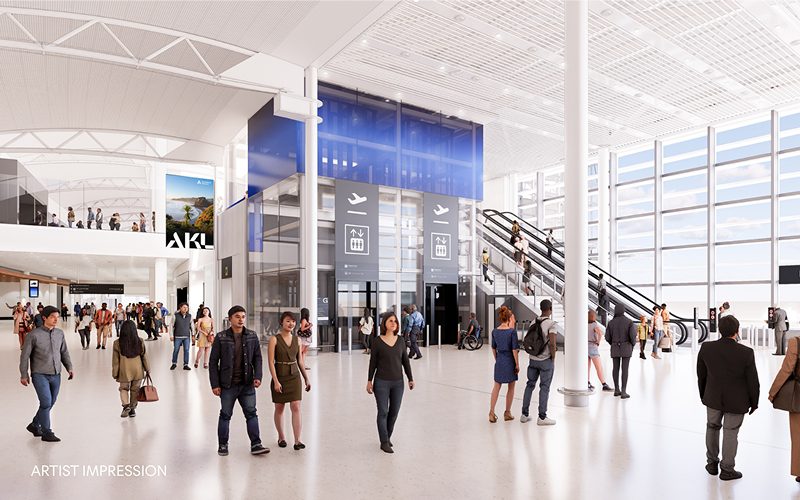
Construction work continues in and around the international terminal as the check-in transformation progresses. Activities are being carefully staged to minimise disruption, with wayfinding, temporary facilities and operational planning in place to maintain safe access for travellers, visitors and airport workers.
What's changing?
Zone C: Check-in Zone C remains behind hoardings as work continues on the first stage of the future common-use self-service check-in environment.
Zone T: The temporary pavilion Check-in Zone T will support increased airline operations with extended operating hours during the upcoming summer peak period from late October.
Zone E: New hoardings are in place to support terminal façade works, with additional hoardings and a temporary elevated working platform to be installed during October. Check-in operations will continue as normal, with signage and wayfinding updated as needed.
Tui Bridge: Deconstruction of the bridge near Zone B is entering its final stages, with temporary barriers and work zones remaining in place.
Terminal forecourt and amenities
Underground services work continues in the forecourt as part of the wider terminal integration programme. Temporary covered walkways, updated wayfinding and pedestrian access routes remain in place, and travellers may notice hoarding lines and routes changing from time to time as work progresses.
From late September until the end of the year, some bathroom facilities in and around the international terminal will temporarily close in stages to enable façade works. Alternative amenities will be available nearby and clearly signposted.
September 2026
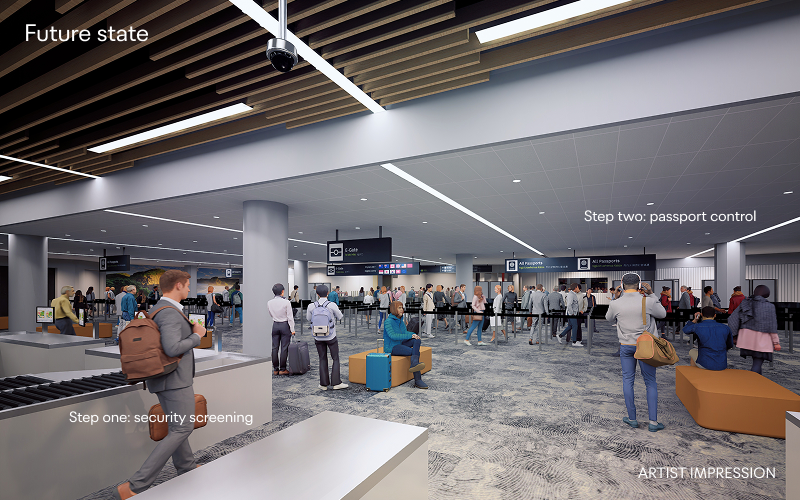
As we prepare for domestic jet and international travel together under one roof, updates are being made to the international departures journey. While some steps will be completed in a different order, the overall experience will remain familiar.
After check-in, international travellers will still go through security screening and passport control, but over time the order will change, with security screening moving first, followed by passport control, aligning Auckland Airport with international airport practice.
Known as ‘The Flip’, the project will help prepare for the future integrated terminal and will be introduced in stages through to the end of 2027. Travellers may follow different pathways as they enter the departures area while work is carried out and should continue to follow airport signage and the directions of frontline staff. Auckland Airport, New Zealand Customs Service and Aviation Security Service are working closely together to deliver the change.
You can read more here.
August 2026
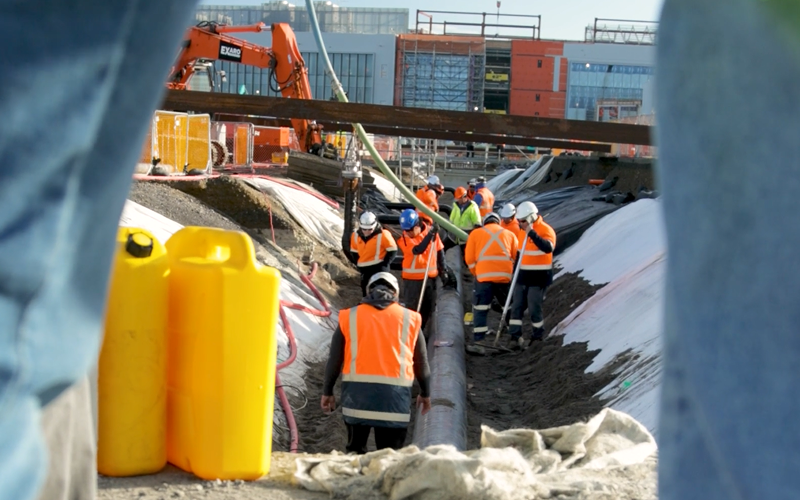
A new one-kilometre fuel pipeline has been installed around the future Domestic Jet Terminal pier, marking another key milestone for the project. Connected to 30 underground hydrants, the pipeline will allow aircraft to refuel directly from the airfield once the terminal opens.
Milestone highlights
The pipeline has been installed two to three metres below ground around the terminal pier.
It connects to 30 hydrants and will support both narrow and wide-body aircraft.
Direct refuelling will reduce fuel tanker movements across the airfield and support a more efficient and resilient fuel network.
The milestone was delivered with support from McConnell Dowell, which carried out the airfield works associated with the pipeline installation.
August 2026
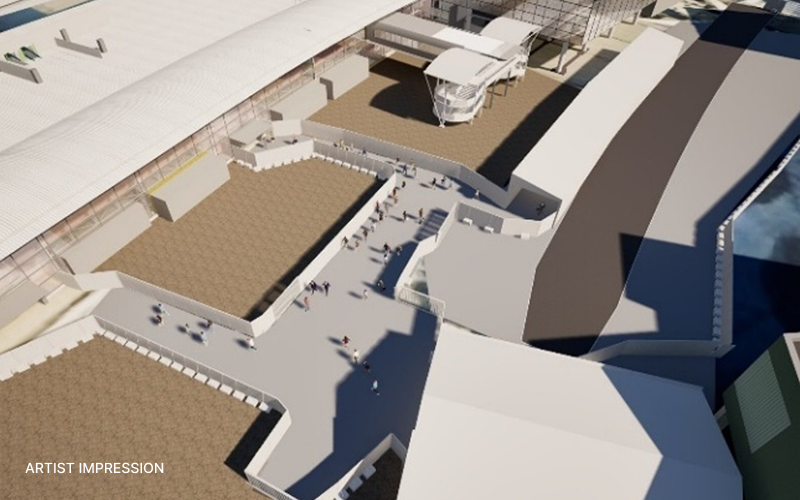
Work continues on our check-in transformation upgrades, with a range of temporary access improvements now in place to support construction while maintaining safe and accessible routes for travellers, airport workers and visitors.
Recent changes include the installation of temporary covered walkways and canopies, updated wayfinding, and temporary pedestrian access around the international terminal. These upgrades help support day-to-day airport operations while improvements to the check-in hall and terminal façade continue.
Construction activity is also progressing to prepare for future terminal enhancements, including façade upgrades and the introduction of common-use self service technology. As work ramps up in and around the international terminal, construction activity will become more visible to travellers. Workis being delivered in stages to minimise disruption, with terminal facilities, retail outlets and key access routes remaining available throughout the programme.
Looking ahead: Check-in transformation will create a more modern and flexible check-in experience while supporting the long-term development of Auckland Airport's international terminal. As construction progresses, travellers may notice temporary changes to access routes, with signage and customer support in place to help people navigate the area.
August 2026
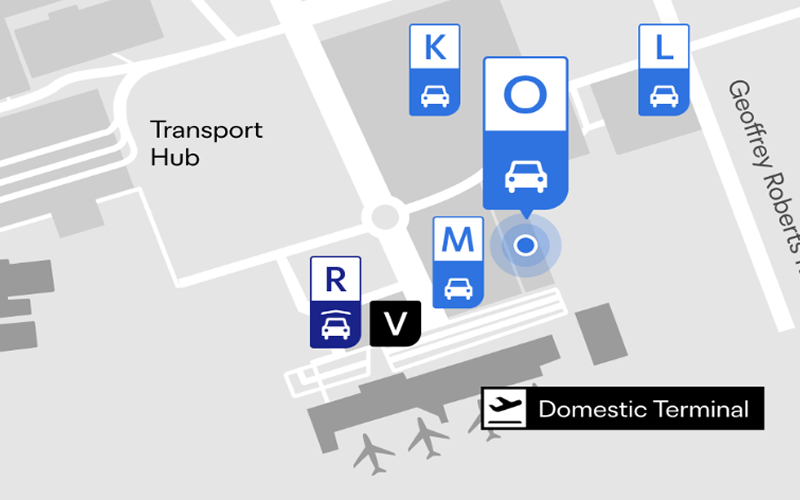
An important milestone has been reached in Auckland Airport's regional airfield expansion project, with the completion of the first major landside phase of works. This has enabled the relocation of Car Park O and the introduction of a new commercial road layout at the domestic terminal.
The updated road layout supports taxis, rideshare services, buses, shuttles and other commercial operators, while creating the space needed for the next stage of regional airfield expansion works.
The regional airfield project is a key part of our long-term master plan, delivering four new regional aircraft parking stands and 8,500m² of additional airfield space to support the future growth of regional aviation.
July 2026
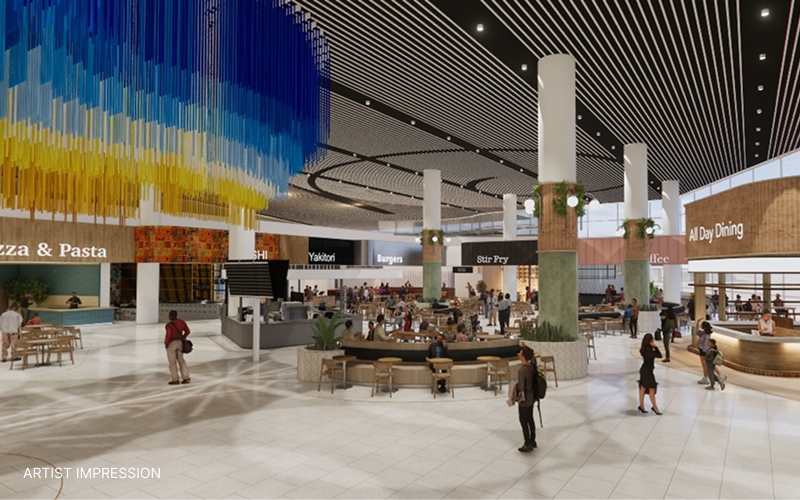
The international departures dining precinct is being upgraded in stages throughout 2026, bringing new and refreshed dining options, 2,600sqm of new flooring, 15% more seating, and upgraded device charging points.
Works are being rolled out in planned stages to minimise disruption while delivering a more modern and comfortable dining experience for travellers. Alongside upgrades to the dining precinct, a new line-up of food and beverage operators will open progressively throughout the year, combining well-known brands and local favourites to offer travellers more choice before they fly.
What's happening
- New and refreshed dining offerings will open progressively throughout 2026.
- Flooring replacement, additional seating and upgraded charging facilities are being delivered as part of the programme.
- Works are being completed in stages, with food and beverage outlets remaining open throughout construction.
- There is no impact to passenger pathways or gate access.
New and refreshed dining on Level 1 is targeted for completion by the end of 2026, creating a more vibrant dining precinct and enhanced experience for international travellers.
You can read more here.
July 2026
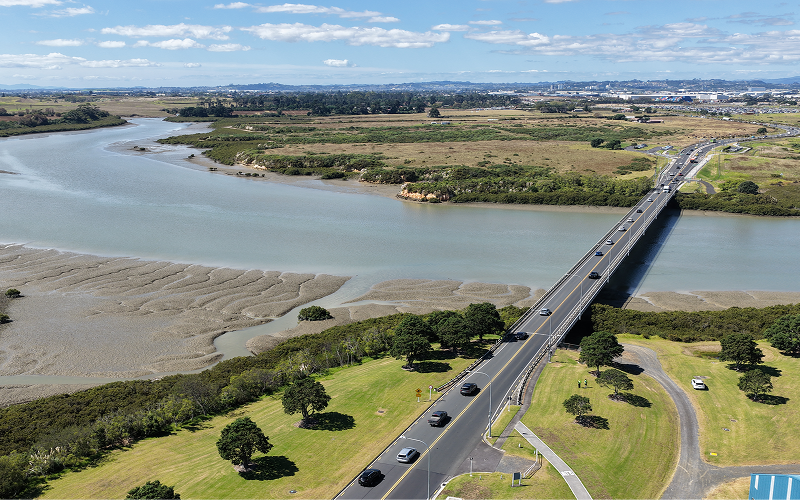
Work is underway on the Pūkaki Bridge upgrade, which will introduce dynamic lane management to help improve traffic flow to and from the airport precinct. Dynamic lanes will allow lane directions to change in response to peak traffic demand, providing two lanes in the busiest direction during morning and afternoon peak periods.
The project will also deliver improvements for pedestrians and cyclists, alongside upgrades to stormwater infrastructure.
What to expect
- Construction is expected to take approximately six months, with dynamic lanes expected to go live in early 2027.
- Traffic will continue to operate in both directions during the day.
- Some temporary lane restrictions may be required during overnight works, with advance notice provided where possible.
- Once complete, the dynamic lane system will help improve traffic flow during peak travel periods.
How this will improve access
The Pūkaki Bridge upgrade is designed to improve access to and from the airport precinct while supporting future growth and providing better connections for motorists, cyclists and pedestrians.
May 2026
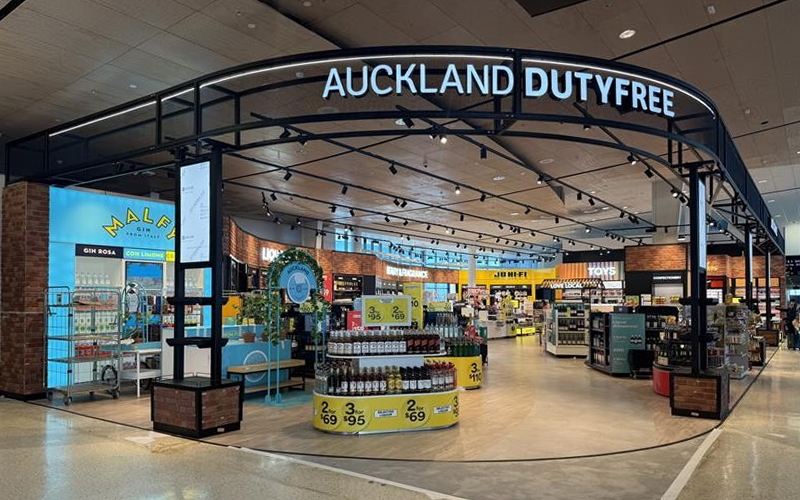
Transformation of our Duty Free stores is well underway, delivered in partnership with Lagardère, with all upgrades on track for completion by end of 2026. The programme is about creating a vibrant, contemporary retail experience designed around how today's travellers want to shop and move through the terminal.
Pier A and Pier B stores
The newly renovated Duty Free store in Pier B reopened on 21 March, and the upgraded Pier A store recently - featuring an improved fit-out and an expanded range of brands in a more inviting shopping environment.
Departures upgrades
Work in the international departures Duty Free space is progressing well, with Stage 1 now complete. The new entrance and upgraded walkway are in place, allowing the staged refurbishment to continue. Departures Stage 2 is nearing completion and will open later next month, with Stages 3 and 4 to follow.
Upgrades to the Duty Free space in international arrivals will also continue throughout the year. All works are being delivered in stages to minimise disruption to travellers.
May 2026
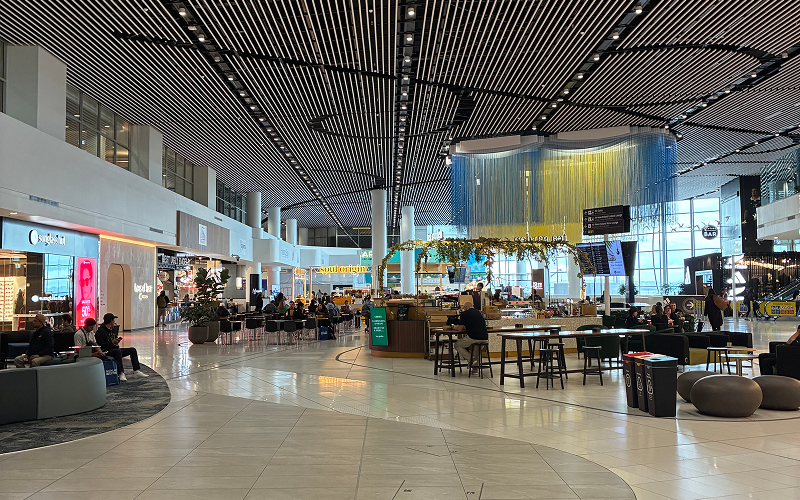
Upgrade works are underway in the dining area of the international terminal, delivered in planned stages across the remainder of the year to keep disruption to a minimum for passengers and retailers.
Staged tiled flooring replacement
New floor tiles are being installed on Level 1 of the international terminal's airside dining area. Works are staged to reduce disruption, with a 1.2-metre hoarding installed around the active worksite. Passenger pathways and sightlines to shops and restaurants will be maintained throughout. Work is expected to be complete by mid-December 2026.
Level 1 ceiling upgrades
Ceiling extension works above Best Ugly, Hayama, Halong Bay, Better Burger, Mexico and Little Italy are ongoing - all restaurants and retailers remain open and trading as usual. Noisier work is carried out after hours to minimise impact. Work in this area is expected to be complete by June, with further ceiling upgrades continuing across other parts of the dining precinct throughout the year.
April 2026
Pier piling now complete
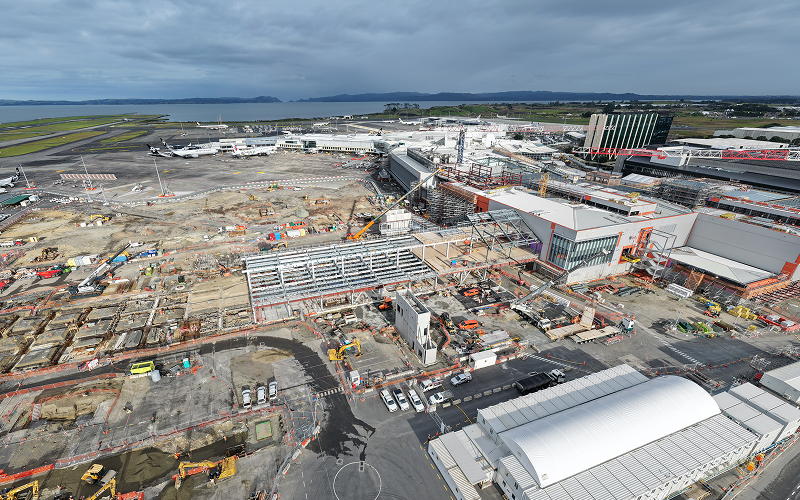
Work on the Domestic Jet Terminal (DJT) is progressing well. Pier piling is complete, with the steel structure now approaching the halfway point. When operational, the new 240-metre pier will deliver 12 domestic jet stands with fixed link boarding bridges.
More than 600 piles have been installed to a depth of approximately 36 metres - strong enough to support over 6,000 tonnes of materials including steel, concrete, timber flooring and roofing.
Looking ahead:
- Completing the building envelope and glazing to headhouse north
- Ongoing roofing and weather-tightness works
- Staged fit-out progressing from the Headhouse into the pier
- Installation of the new airfield fuel hydrant network
- Steel structure for the new baggage handling system in the Eastern Bag Hall
The new integrated terminal will bring domestic and international travel under the same roof for the first time since 1977.
You can read more here
April 2026
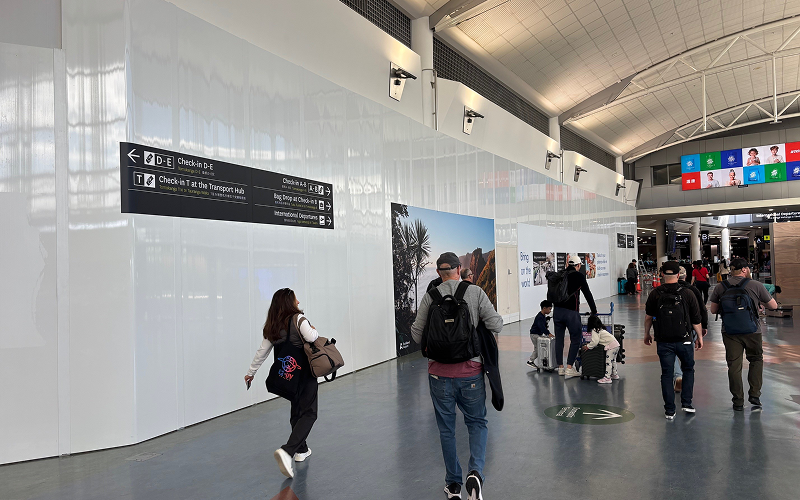
Changes are underway around the international terminal forecourt to support upcoming check-in transformation works. Some areas are now behind hoardings and pedestrian routes have shifted. Wayfinding and on-the-ground support are in place to help travellers and precinct users navigate the changes.
Retro Espresso on the move
Retro Espresso has relocated to a new spot next to the bag wrap station within the Transport Hub, outside Zone T, to accommodate check-in transformation hoardings.
New raised pedestrian crossing
A new raised pedestrian crossing has been installed to support changes to terminal access. Door 6 will soon become the primary entrance for Zone A, with updated wayfinding and signage to follow once the route is complete.
Green Line changes
The Green Line has been adjusted around new hoardings, continuing to guide travellers, airport workers and precinct users from ITB Door 8 to the domestic terminal, and into the international terminal via Doors 3 and 4.
Hoarding changes and Door 5 closure
New external hoardings will be installed and existing hoardings adjusted to support planned canopy and container walkways between Zone T and the terminal. In the meantime: Door 8 should be used to exit the terminal; Doors 6 and 7 to access the smoking area; and the pathway between Doors 4 and 6 will be closed. Wayfinding will be updated and an AKL team member will be on hand to help. Further changes will follow once the container walkways are in place.
April 2026
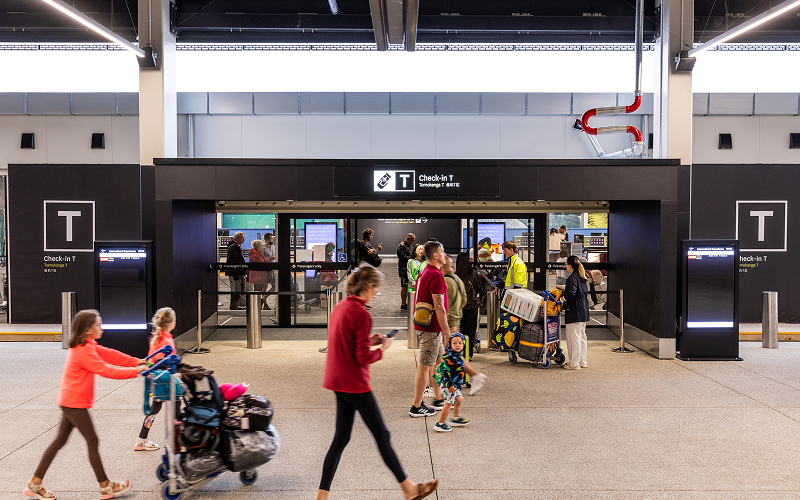
Our new temporary check-in location, Zone T, is officially open and performing well since its 26 March go-live - supporting capacity through the staged check-in transformation programme.
The 2-step check-in and bag drop process is flowing smoothly, with teams on hand to support travellers. Daily reviews continue as we embed Zone T across airline partners, ground handlers and AKL teams. Zone T is expected to be in operation for approximately 2.5 years.
Construction is now underway in the check-in hall, with Zone C behind hoardings for approximately four months. Planning is also underway for a canopy and container walkways between Zone T and the terminal.
What’s changed:
- Some international flights are now checking in at Zone T.
- Zone C is now behind construction hoardings for approximately four months, before we move to the next zone.
- Travellers will be directed to one of several check-in areas: remaining counters, self-service areas, or Zone T.
How we're informing travellers
Our key message is "Know your check-in zone" - travellers can look up their check-in zone on the Auckland Airport Website 24 hours before departure. This is supported by radio, social media, outdoor advertising, signage, and proactive engagement with travel, tourism, and on-precinct partners. New flight information displays have been installed on key pedestrian routes, and additional staff are on hand to guide travellers.
January 2026
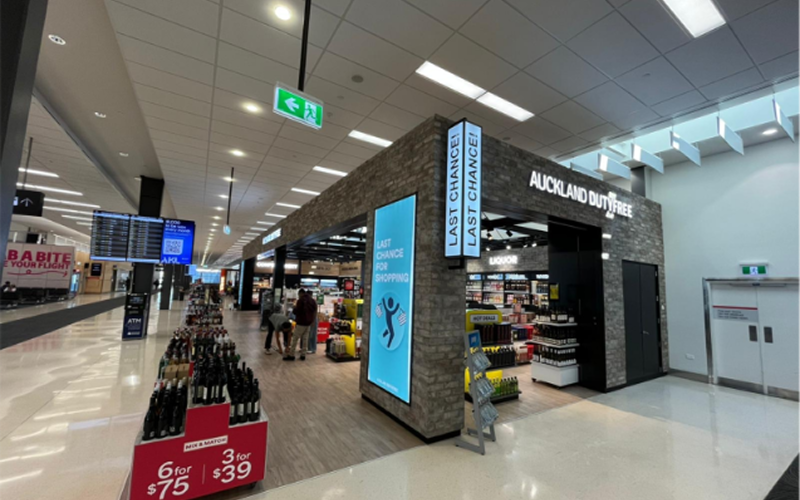
Construction to upgrade the duty-free retail area is underway, as staged works begin in departures duty-free and the duty-free Pier B store.
Completion of the project is expected in late 2026 and will deliver:
- An upgraded duty-free space with a more modern retail environment
- A broader range of brands and experiences introduced progressively.
The works are not expected to impact airport operations or passenger pathways. We are working hard to minimise any construction noise, with noise and vibration monitors in place.
January 2026
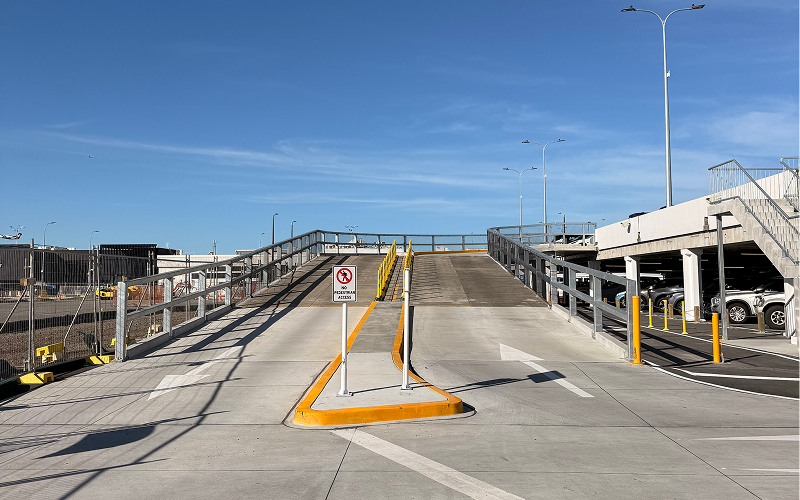
The covered and rooftop sections of Car Park M at Auckland Airport’s domestic terminal have now reopened as we continue to progress the expansion of the regional airfield.
Key details:
- Car Park M is available with a revised layout for multi-day bookings just steps from the terminal, offering greater flexibility for travellers.
- Accessibility parking remains a priority, with spaces available in Car Park M and additional accessible parks in Car Parks R, O, and the front portion of K.
- For extended stays, customers can also use Car Parks K, L, or O.
- Pick-up and drop-off lanes outside the domestic terminal remain unchanged.
December 2025
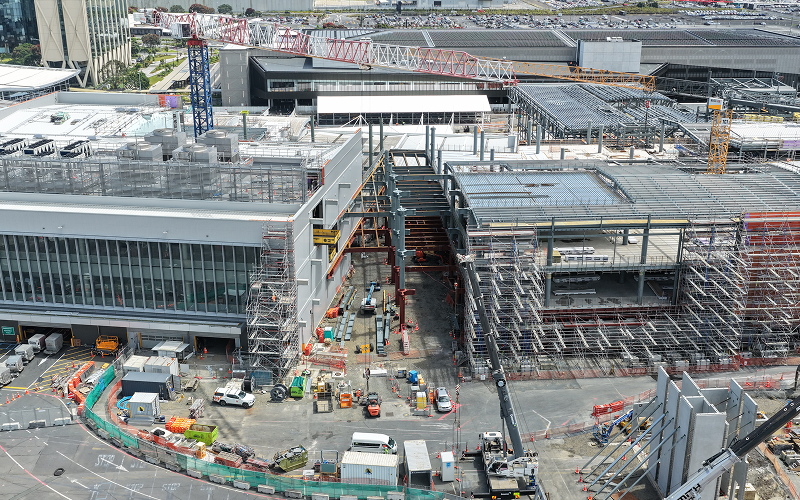
A major milestone in the construction of our integrated terminal has been reached, with the steel of the DJT officially connecting with the eastern baggage hall for the first time. Once complete, the two buildings will create one seamless integrated experience for travellers transferring between domestic jet and international flights.
November 2025
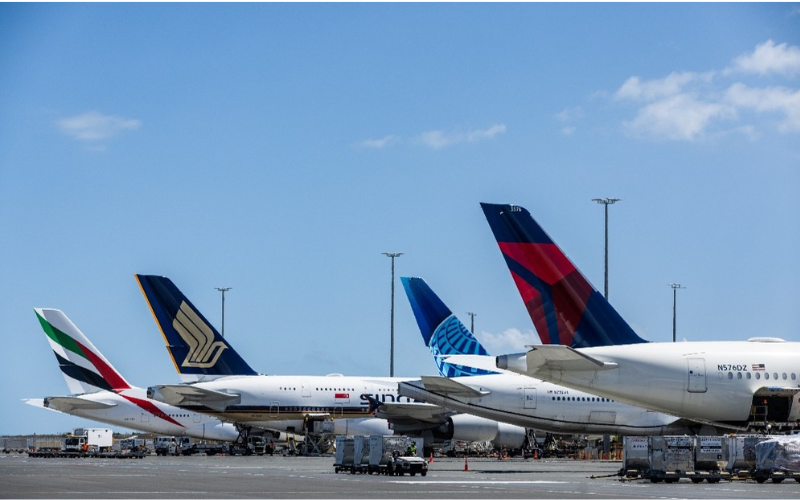
Another key milestone has been reached in the construction of the Domestic Jet Terminal with the reconfiguration of the surrounding airfield.
A change to the airside / landside boundary took place on 19 November and enables:
- Continued construction of the 240m DJT pier
- Future taxiways
- Aircraft parking positions
- Essential fuel and utility upgrades
November 2025
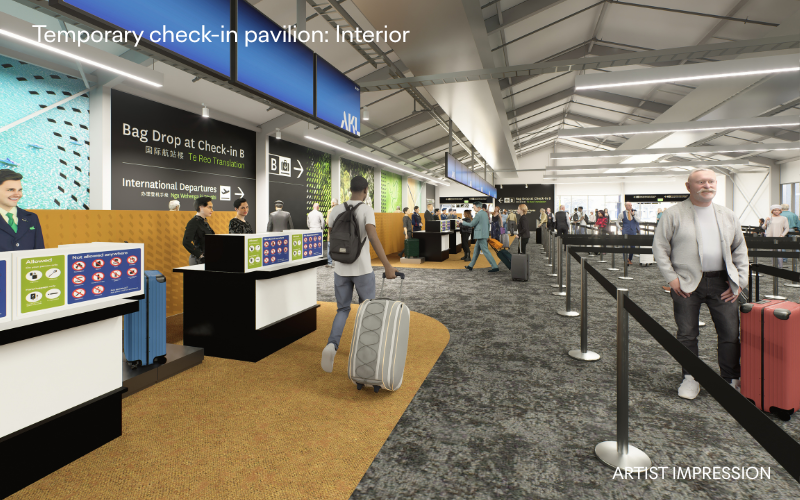
Works are now underway on the temporary check-in pavilion, to provide capacity to support smooth operations during the upgrade of the international terminal’s departure hall.
Key details:
- The facility, to be named Check-in Zone T, will open in autumn 2026.
- It is located between the Transport Hub and the international terminal.
- The structure is 55-metre-long and 20-metre-wide, housing 28 check-in counters and handling travellers for up to four wide-body aircraft at one time.
The check-in pavilion will be a fit-for-purpose, comfortable experience for travellers, who will be able to find their assigned check-in zone 24 hours ahead of flight departure.
The pavilion is essential to maintain day-to-day operations while the international check-in area is progressively upgraded between 2026 and 2029. The upgrade will introduce a modern, flexible check-in experience that will bring domestic jet and international check-in under one roof for the first time since 1977.
October 2025
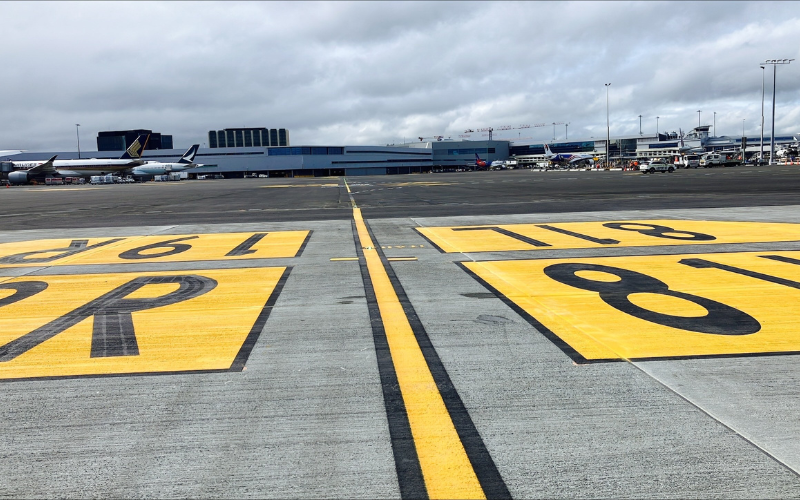
Our pavement programme keeps the airfield operating safely and efficiently and three major projects have just wrapped up:
- Taxiway Lima: central section rehabilitated, new line markings and upgraded lighting installed
- Taxiway Foxtrot: resurfacing and new ducting for power and fuel lines completed
- Stand 81: strengthened with concrete and use of recycled asphalt, concrete and materials designed to extend pavement life.
With around 13,000 aircraft movements every month, this work is carefully sequenced to minimise disruption and ensures the apron, runway, aircraft stands and taxiways remain in top condition.
October 2025
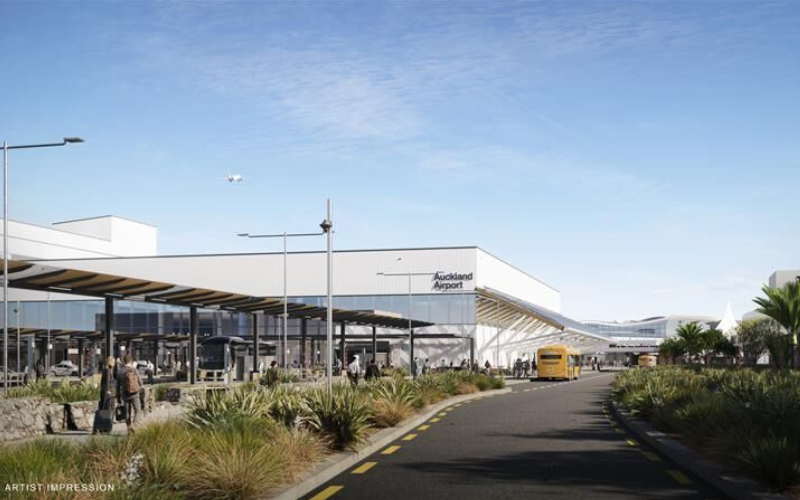
Construction on the first phase of the Inner Terminal Road (ITR) West project began on 6 October.
Above ground, the project will deliver:
- A dedicated drop-off road for shuttles, buses, taxis and rideshare services
- Four new signalised pedestrian crossings connecting to the terminal
Below ground, we’re building a common services trench for utilities and delivering flood-resilience works to protect terminal infrastructure.
As part of this phase:
- Hoardings are being installed to create a safe, separated work zone
- Accessible and VIP pick-ups at Door 11 are moving to the Transport Pick-Up Zone
- Access to the Western Forecourt and Western Truck Dock will remain open at all times
This work, which is the second stage of construction on the ITR, with the section between the Transport Hub and terminal now complete, supports safer, more resilient access to the terminal for both travellers, airport teams and transport operators. Completion is expected in 2027.
October 2025
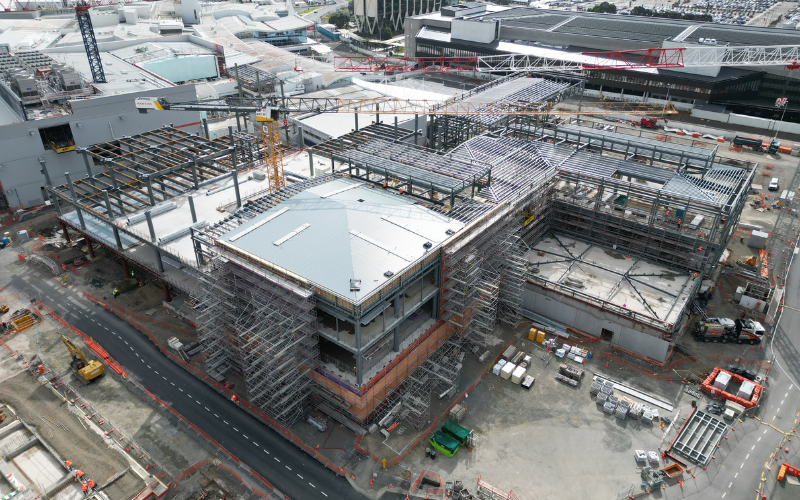
It’s hard to believe how much has changed in just 12 months. September marked a year since we kicked off main works on the new Domestic Jet Terminal with Hawkins Construction.
Since then, we’ve gone from blueprint to building with the headhouse rising, the pier taking form and the terminal’s front face emerging.
The next phase is now underway: reconfiguring and expanding the surrounding airfield. This includes:
- 12 new aircraft stands
- New fuel pipelines and service infrastructure
- Creation of the apron to support the integrated terminal.
To support this work, we’ll soon be shifting the landside/airside boundary around the DJT – a key milestone in bringing domestic and international operations together under one roof.
September 2025
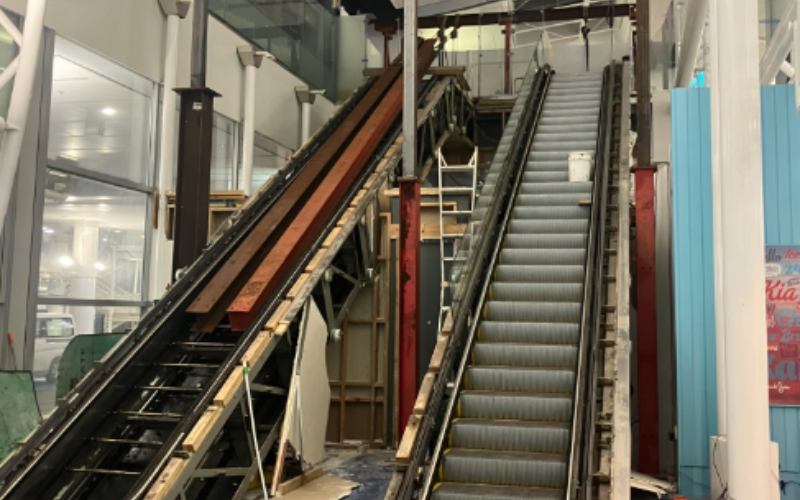
Over the past seven weeks, our temporary arrivals ramp has been ensuring international travellers can continue to make their way smoothly from Customs to the baggage hall while we carry out work to replace the arrivals escalator damaged in the January 2023 floods.
Work on the escalator project has been going well and we’re pleased to let you know that as of Monday 8 September, the escalator is back in action, and we are no longer using the ramp.
With 18.7 million travellers making their way through the airport every year, work on our escalators is important in ensuring the future resilience of our terminals. That’s why on 25 August, we started another escalator project, on the landside escalators at international arrivals.
This work may cause some disruption, but we’re committed to reducing the impact as much as possible. Any activities creating noise will be scheduled during quieter terminal periods, including overnight and during runway maintenance windows. The works will take approximately 10 weeks to complete.
September 2025
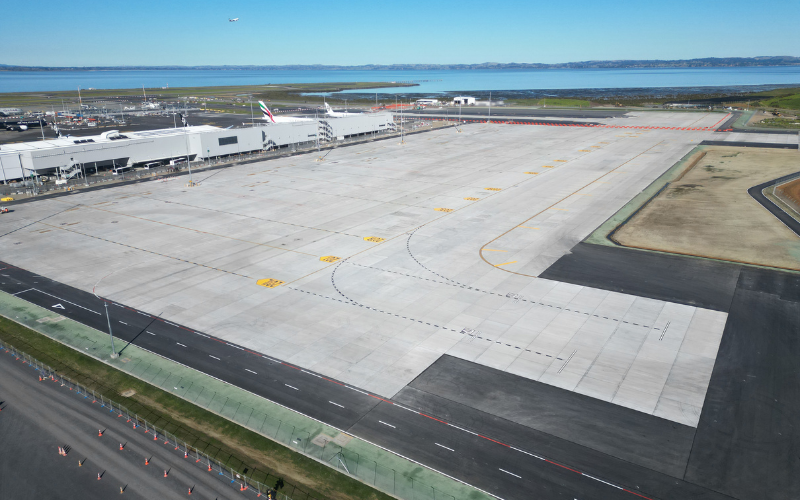
We’re gearing up to open our international airfield expansion, a 250,000m2 addition to our international apron that creates important airfield capacity while we progress the domestic jet terminal build and ensures we are resilient for the future.
The infrastructure works on this project are complete and we’re now well into the operational readiness phase as we anticipate opening in October. But, before any new piece of airfield infrastructure goes into operation, there’s one job, and that’s a FOD (Foreign Object Debris) walk.
This big piece of infrastructure called for a big crowd to help with the FOD walk, so we held an event, inviting key stakeholders and AKL staff to join us in walking the airfield and being the ultimate tidy Kiwis. While there, attendees heard from AKL’s Chief Operations Officer Chloe Surridge, Airfield Programme Director Jason Dardis and Brian Perry Civil project lead David McGoey and enjoyed a delicious morning tea.
This isn’t the only piece of readiness work taking place before the airfield expansion opens. As well as this FOD walk, we’re conducting trials with aircraft to validate the remote stands ahead of live operations. All this work ensures our AKL team, airlines and ground handlers are ready and supported ahead of welcoming our first official passengers.
July 2025
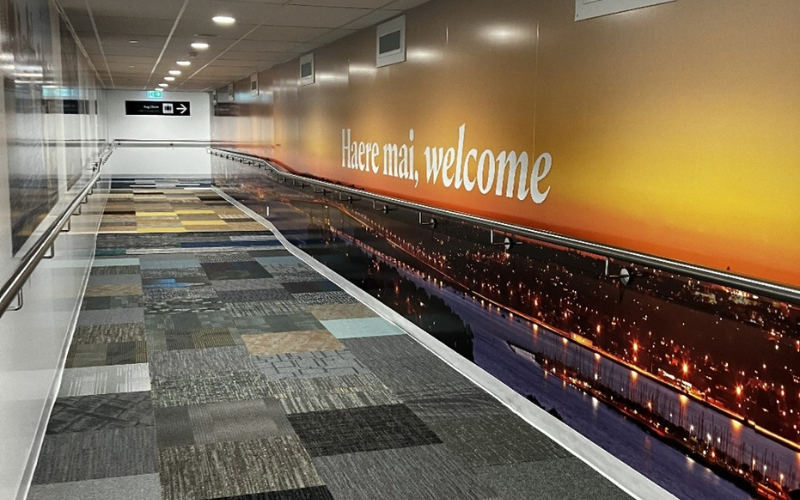
The temporary arrivals ramp for international travellers and flight crew opened on 14 July and will be in place for approximately 8 weeks. The go live took place after a series of trials demonstrated the new set up was fit for purpose and ready to use.
The ramp has been kitted out with carpets, lighting and climate control, and an interior lined with beautiful New Zealand scenery. The design is compliant with accessibility recommendations in terms of slope and handrails, and staff are stationed at the top and bottom of the ramp to assist travellers. Wayfinding is also in place and a hoarding has been erected across the usual pathway to the escalator so it’s clear to travellers which way to go.
The ramp ensures travellers and flight crew arriving internationally can continue to make their way smoothly from customs to the baggage hall while we replace the arrivals escalator that was damaged in the January 2023 floods.
This project exemplifies the careful coordination of works within our development programme and effective collaboration among airport stakeholders, enabling the continued operation of the airport while delivering these significant upgrades.
July 2025
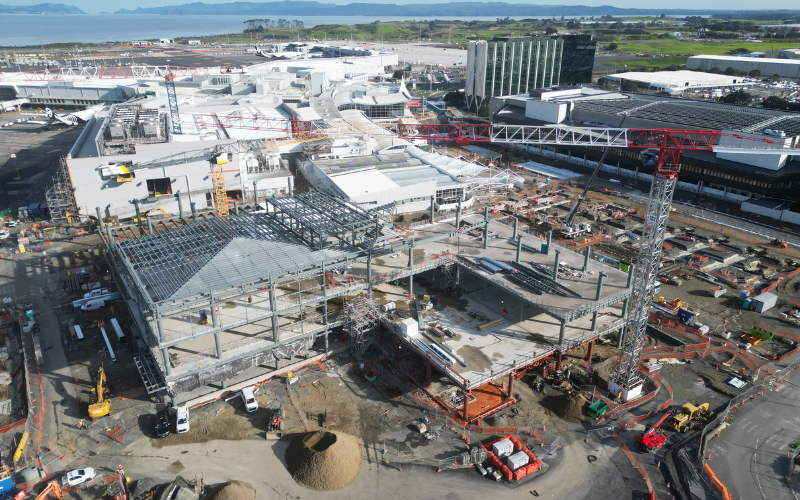
The Domestic Jet Terminal (DJT) team has been very busy in the last few months with some key milestones reached and new phases of work underway.
The opening of the Western Loading Dock in June has allowed for the closure of the Eastern Loading Dock, and its access road, which previously ran through the DJT construction site. This has allowed the DJT team to reclaim that space, and finish piling for the two main structures of the building – Headhouse North and Headhouse South – including the ‘wedge’ which is the important connection between Headhouse South and the International Terminal.
With piling complete in these areas, the team is now able to move onto installation of the structural steel frame and floor slabs. In areas where the main structure is completed, initial preparations for the roof have also commenced, marking another significant step towards achieving watertightness.
The only remaining piling work is on the pier which will jut out from the existing landside construction site into what is currently part of the airfield. To facilitate further work on the pier, the team is targeting a shift in the airside/landside boundary later this year.
In addition to all of this, the DJT’s site village, which will provide a dedicated space for coordinating construction efforts on this important project, is on track for completion by mid-August.
There really is so much exciting work happening in this space. We can’t wait to see the skyline around the terminal continue to change as the roof takes shape over the coming months.
July 2025
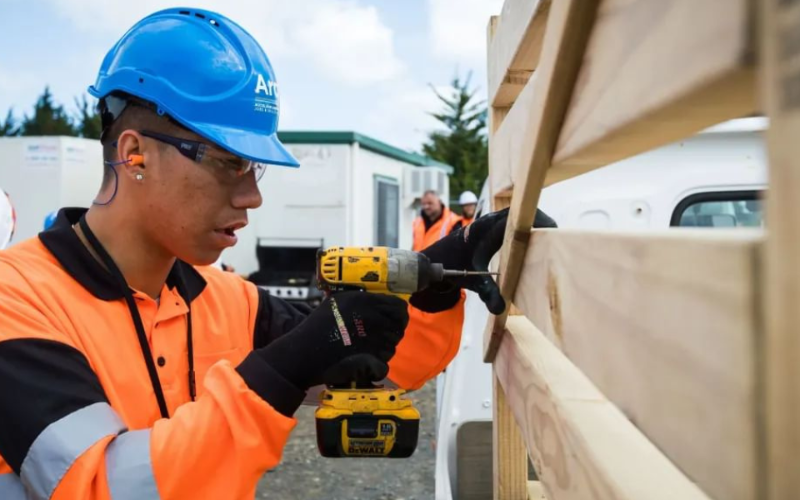
Ara, which means pathway, is Auckland Airport’s Jobs and Skills Hub, connecting South Auckland people with job and training opportunities close to home. Ara was founded by Auckland Airport to deliver long-term employment pathways, and Ara’s success has been shaped thanks to fantastic support from precinct businesses and the construction firms delivering our development programme.
Hawkins, which is delivering the domestic jet terminal, has proudly partnered with Ara for many years as a way to help rangatahi (young people) explore career opportunities available in the construction industry. In June, Hawkins welcomed four new students – Peter, David, Hugo and Roman – to work with them on the DJT site. They’ve got additional cohorts joining for the September school holidays and for a longer period over the end-of-year summer break.
On site, Ara students gain hands-on experience in areas such as carpentry, health and safety, and site operations. The Hawkins team work closely with subcontractors to ensure students are placed in the right roles, receive meaningful training, and are supported by mentors. And as the DJT project grows, so too will the number of students Hawkins can support.
The crew at Ara also offer support to precinct employers in the form of training and recruitment services. If you have roles to fill on precinct, the Ara team can make the recruitment process smooth and successful. They also provide a convenient location for hosting training sessions. Make sure you get in touch with the Ara team.
New Ara recruits join Hawkins on site at the DJT
June 2025
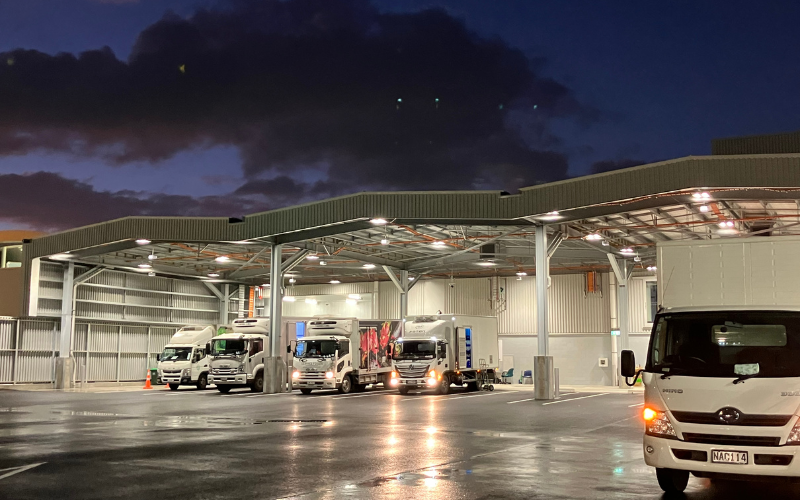
On Friday 27 June, we marked the successful completion of four foundational pieces of infrastructure; the new western loading dock, expanded international arrivals hall, purpose-built baggage tracing unit offices and new NPS facility. These projects are critical to Auckland Airport’s transformation and were delivered while maintaining 24/7 airport operations in a live, complex environment and delivered in close collaboration with joint border agencies. These projects were also delivered without a Lost Time Injury in the over 319,000 construction hours completed.
It was great to be able say thank you to our amazing airport partners, who collaborated with us and worked hard to make the project happen over a cup of tea. The event was attended by representatives from Auckland Airport, the Ministry for Primary Industries, Immigration New Zealand, the Civil Aviation Authority, Built Environs, and other key partners and hosted in the new arrivals hall space.
June 2025
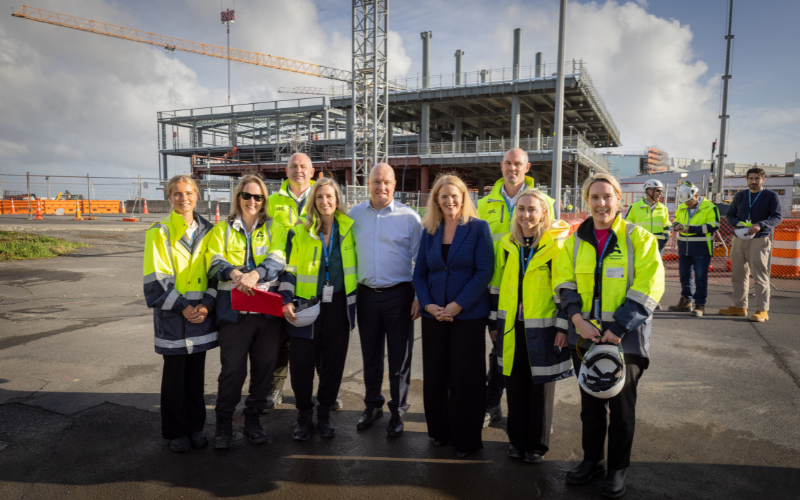
The site of our domestic jet terminal (DJT) construction has been a popular spot in recent weeks with visits from some VIPs.
It kicked off on Friday 30 June with a Critical Risk Safety Walk by Downer CEO Peter Tomkins and AKL’s Chief Executive Carrie Hurihanganui. Carrie and Peter spent valuable time with the DJT project team looking at the impressive progress made on the project to date and commenting on positive safety initiatives.
Carrie then returned to site last week to host Prime Minister Rt Hon Christopher Luxon, and Minister for Tourism and Hospitality Hon Louise Upston. After the tour, the PM announced a $13.5 million investment in international tourism marketing and expressed his confidence that travellers arriving at our new terminal would have a great first impression of New Zealand.
The DJT was particularly busy that day because Her Excellency Iona Thomas, UK High Commissioner, and Carolyn Harris, Member of the UK Parliament, also toured the site. They were invited by UK company Mott MacDonald, one of the consultancies working on the DJT, and also heard from our airport team about the draft Master Plan. They were very impressed by the scale of the build in a live airport environment and said they believe the new terminal will put Auckland Airport on par with other international airports.
April 2025
We’re progressing key surface level and below ground elements as part of expanding our Northern Airfield.
On the surface, we’ve nearly finished laying the concrete slabs for the expansion of the airfield, with only a small corner of the area still to be filled in under the location of our new remote stands. Over the next two months, we’ll complete the concrete pavement for the extension of Taxiway Lima to provide access to these new stand areas. This expansion will provide five new fully serviced stands for passenger aircraft, an additional un-serviced stand for cargo or parking, as well as remote space for overnight parking if we need it.
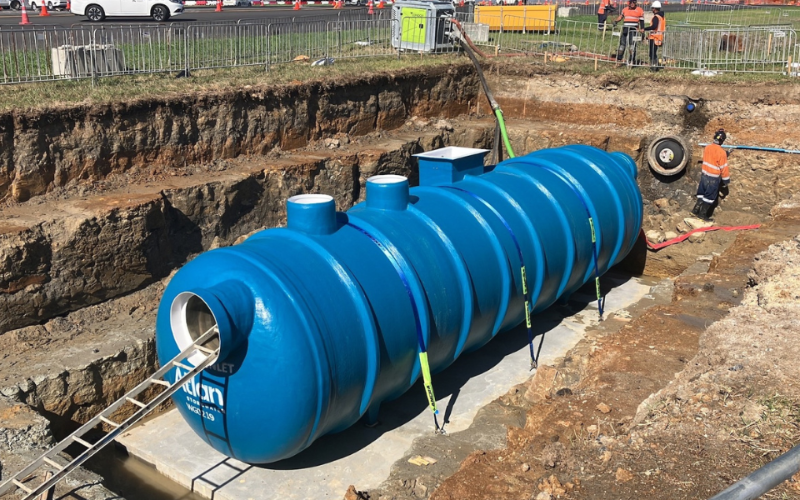
Below ground, upgrade work has continued on our extensive stormwater network with a new Stormceptor being installed next to Taxiway Lima. It’s a device that intercepts and removes pollutants from stormwater run-off before discharging it to the western wetlands.
February 2025
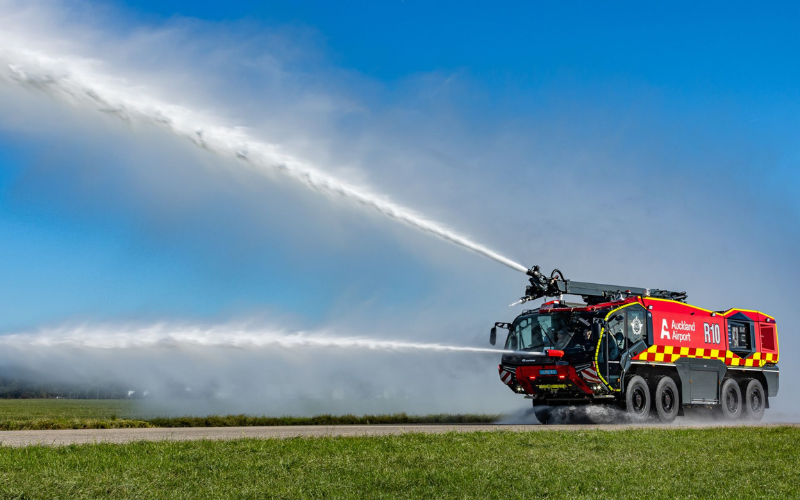
Recently we formally welcomed the latest addition to our firefighting team - a first-of-its-kind Panther fire truck.
Manufactured by specialist Austrian company Rosenbauer, our new Panther 8x8 HRET fire truck is marketed as the very top of the food chain. We are the first airport in the Southern Hemisphere to invest in this model, and it joins the existing fleet of four 6x6 Panthers.
The 8x8 HRET has greater water capacity than our existing fleet and the extendable turret allows the AES team to deliberately and safely direct water in close, instead of running out a hose.
The investment is part of our wider commitment to keep growing our emergency capabilities as the number of flights and travellers passing through the airport grows.
February 2025
Steel columns are being craned into place as vertical construction begins on the main building of Auckland Airport’s new domestic jet terminal.
Rising up to 21m above the ground, the columns will become the support structure for the domestic terminal headhouse – the main engine room of the new terminal.
The headhouse will contain the domestic arrivals and baggage pick-up area, traveller amenities, operational management spaces, airline lounges and dwell spaces, plus a new state of the art baggage system.
Each column for the structure makes a pre-dawn journey on truck and trailer from the west Auckland fabrication workshop of D&H Steel Construction.
The 12,000m2 facility has been busy working on the airport job since late last year, with a 50-strong fabrication team working two 10-hour shifts to prepare 1,600 tonnes of column steel and another 3,000 tonnes of associated steel structures such as floor beams, lift shafts, roof structures and façade support for the initial stage of construction.
The five-year long project is due for completion in 2029.
February 2025
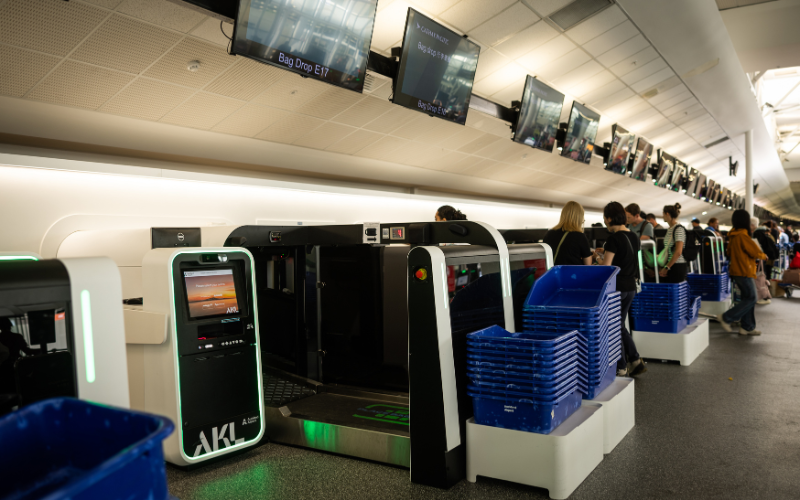
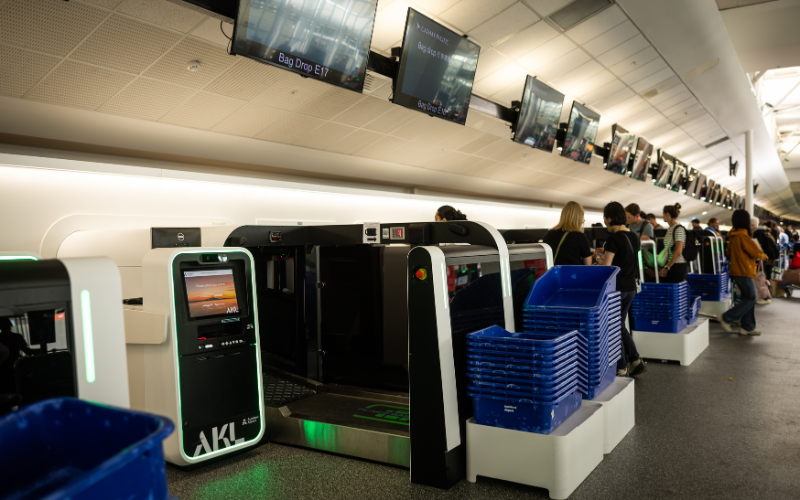
New self-service kiosks and bag drops at the international terminal have now gone into operation and are being used by our passengers for checking in. We’re starting with a small group of five airlines as early adopters and will then progressively add more airlines. Over the next few years around 100 existing check-in counters will be replaced with self-service kiosks and bag drops.
When complete, the new self-service kiosks and bag drops will be available to all travelers no matter what airline they’re on, meaning multiple airlines can be checking in from the same kiosks in a zone at the same time. Although much of the process will be self-service, airport and airline teams will still be on hand to support travelers and with the Interim Zone E it is no different. Friendly airport staff will be on hand to assist any passengers who need help.
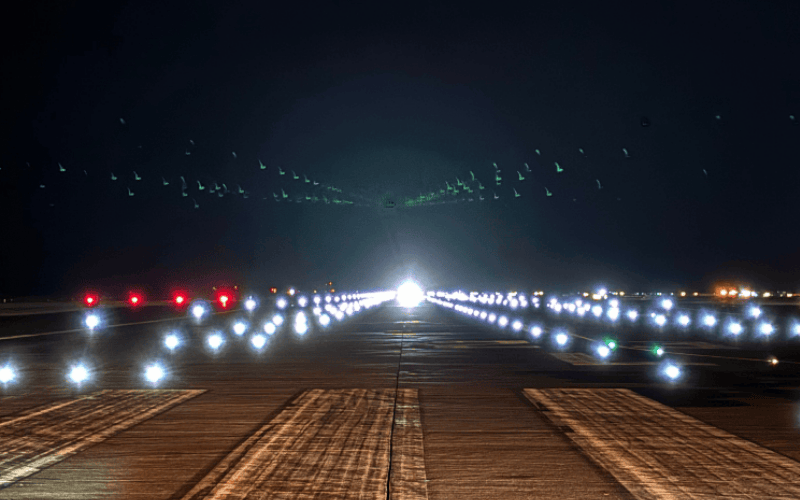
Our runway is being seen in a whole new light with a switch to LED runway lights to guide aircraft during take-off and landing. Shining bright down the length of the 3.6km runway, around 600 light-emitting diode (LED) lights, have replaced a halogen lamp system – work all done under the cover of darkness.
The 240 new LED in-ground runway centreline, 186 touchdown zone, 52 threshold, 124 runway edge and 18 runway end lights now in place will be individually tracked and monitored with all details digitally recorded. From the moment an LED light is installed we have a full record of its performance – including a complete log of every time it is cleaned or the bolts tightened through to any maintenance done.
New self-service kiosks and bag drops at the international terminal have now gone into operation and are being used by our passengers for checking in. We’re starting with a small group of five airlines as early adopters and will then progressively add more airlines. Over the next few years around 100 existing check-in counters will be replaced with self-service kiosks and bag drops.
When complete, the new self-service kiosks and bag drops will be available to all travelers no matter what airline they’re on, meaning multiple airlines can be checking in from the same kiosks in a zone at the same time. Although much of the process will be self-service, airport and airline teams will still be on hand to support travelers and with the Interim Zone E it is no different. Friendly airport staff will be on hand to assist any passengers who need help.